Why do missions start up in one area and not in another? How long does it take after one begins the process until a mission is actually birthed? How do you go about starting a mission? These arequestions I’ve been asked over and over again. The best way I can answer is to share my experience about a mission which I’ve had the privilege of helping to found.
The mission of St. John the Baptist was born in Coeur d’Alene, in the state of Idaho, to the Antiochian Archdiocese on Sunday, November 19, 1995. Like all births, it came into being in travail. Coeur d’Alene is located on the eastern side of the Cascade Mountains, just east of Spokane, 100 miles south of Alberta in Canada, with Montana hugging its borders to the east. It is majestically nestled amidst Northern Idaho’s proliferation of pine trees, glacier lakes, and exquisite golf courses. The Idaho Panhandle, as this area is called, had not seen the likes of an Orthodox Church in its lifetime; neither had central Idaho. Hence, St. John the Baptist is a mission in the truest sense of the word.
Many have come to the Northwest to find sanctuary from the tyranny of city life, with its rising crime, drugs, and congestion. Before making my decision to move with my husband to this peaceful haven, I inquired as to whether there was an Orthodox church in the area. From August 1992 until November of 1995, I willingly made the two-hour round trip to Spokane as a new member of Holy Trinity Greek Orthodox Church, where I worshiped for three years—serving on the Parish Council, teaching Sunday School, heading up a Women’s Spiritual Circle, and enjoying the benefits of having such a wonderful priest as Fr. Stephen Supica and his devoted Presvytera Irene.
Fast forward to the climactic point of our third Lenten season here—that point of culmination when we shift gears from dark colors (black and purple) to light colors (white and gold), from repentance and sorrow to forgiveness and joy, from night to day, from chaos to peace, from despair to hope, and from fasting to feasting—the feast known to Greeks as Pascha. It is the time when our Lord, through the shedding of His unblemished blood, “passed over” death to life, just as the Israelites had done thousands of years before in Egypt, when the angel of death “passed over” those doors whose lintels were covered with the blood of an unblemished lamb, also granting them life.
During three years of driving to and from Holy Trinity, Washington’s border had become a more familiar sight to me than my husband, and my odometer was rising quickly. So, on that fateful Good Friday in 1994, half-jokingly but very exhaustedly, after driving a total of four hours back and forth for the day and evening services, I said to Fr. Stephen, “I think it’s time to start a mission!”
It became apparent to me that Fr. Stephen had meditated upon my words when, only a few short weeks later, he asked me if I knew Fr. Philip Nixon, who was visiting from Twin Falls, Idaho. I didn’t, so he introduced us. Fr. Philip had moved from California to the southern part of Idaho, where he had established the Mission of St. Ignatius of Antioch. It was a fruitful encounter. Of course, we were merely manifesting God’s divine providence. Almost immediately, plans were made for Fr. Philip to come up on a weekend, at which time we had a dinner meeting at our home and vespers at a local church. Three such gatherings took place over a period of three to four months.
In the meantime, I had rounded up as many people in the area as I could. The phone became my constant companion and an extension of my persona with the blessing of Fr. Stephen. I called all the Orthodox I knew in the Panhandle and called the local paper to run a story. The last meeting with Father Philip took place in July of 1994. After that, we met with silence for another year.
That silence was broken by the ring of the phone at my home the following July. It was our precious Father in Christ, Fr. Philip, at last. “Joy,” he said, “Fr. Peter (Gillquist) hasn’t forgotten about you. It seems he got a phone call from a priest back East who is interested in taking on a mission. When Fr. Peter went over the list of possible locations for a mission, this priest stopped him at the name Coeur d’Alene and asked, ‘Where in the world is Coeur d’Alene?’”
It wouldn’t be long before we would meet this young, dynamic, multi-talented, and spiritually gifted priest, and it wouldn’t be long before he would know exactly where Coeur d’Alene was in the world—and exactly where God was sending him!
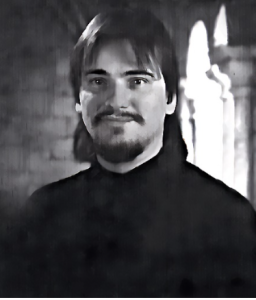 Money was raised for an airline ticket and, in a matter of a few weeks, my sister and I were excitedly running up the stairs in the Spokane Airport, wondering what this priest would be like. As I quizzically perused the crowd, I could see the head of a young, slight figure topped with a cap, enthusiastically bobbing up and down, and I just knew this was him. Sure enough, I didn’t have to wonder any longer when I heard the words, “Which of you two ladies is Joy Corey?”
Fr. Gregory Horton was his name. We talked and talked for hours into the night. The next day, Fr. Philip Nixon arrived from Twin Falls. A small crowd gathered that evening at St. George Roman Catholic Church, our borrowed facilities, where we held Saturday Vespers together. Fr. Gregory addressed us later, and although the group was small, he sensed that here in North Idaho was the dedication to get a mission off the ground.
This is the key to a mission succeeding: it isn’t in the numbers—it’s in the dedication. We knew we had a priest who was called by God to mission work. Not all priests can do this kind of work. It is a real calling! He wasn’t discouraged by the numbers, and he wasn’t worried about money, which was good since we couldn’t offer him much! The success of a mission is not only incumbent upon the sacrifice of the priest but also upon the sacrifice of his wife and children if he is married. Fr. Gregory’s wife was willing to work and make sacrifices. It is the greatest blessing for a priest to have such a wife. Indeed, Fr. Gregory was blessed with a wife who understood the “missionary” calling.
This was the middle of August. Three months later, Fr. Gregory arrived in the midst of a wintry storm with his beautiful and most dedicated Khouria Cindy, their four children—Tatiana, Maximos, Sebastian, and Benjamin—two cars (one driven by him and the other by her), with a borrowed pair of walkie-talkies as their sole means of communication as they traveled the treacherous winter roads. They brought nothing but their clothing, their cat, and, most importantly, an iconostasis, icons, church music, liturgical supplies, and all the enthusiasm, love, devotion, and commitment needed to give birth to a mission.
Doctors have their medical supplies; Father had his liturgical supplies. Notice: no material possessions, but simply evidence of the hearts of true missionaries. He brought with him our choir director (Khouria Cindy) and our first two altar boys (Maximos and Sebastian), with a third altar boy in the making (Benjamin, then 2), and a choir member in training (Tatiana, then 9).
So, how do you start a mission? With dedication, desire, and hard work. How long does it take? As long as it takes to find a priest who has evangelical fervor, is willing to work hard, reach out with vision to the community around him, and sacrifice the material for the eternal. You put ads in the paper and get the local newspapers to run stories on as many of your activities as possible. You don’t look to start a mission in an area where an Orthodox church already exists. If there had been an Orthodox church in Northern Idaho, given its population (50,000), we would not have begun a mission.
Jurisdictions are not important. We loved going to the Greek church in Spokane. But there were other Orthodox who remained unchurched because of distance, and we felt that since hardly anyone out here had ever heard of an “Orthodox Church,” we had better take seriously the great commission of our Lord to preach and to teach and to baptize in His Name.
Christ was addressing “The Church.” We are “The Church.” It isn’t the fault of the people around us if they do not know what the Orthodox Church is. It is our fault! Coming from an ethnic background and being a cradle Orthodox as I am, I’ve been asked by other cradle Orthodox who are members of ethnic parishes, “Why do you want Americans to come into your church?” I respond to this: “Because I do not want to stand before the Dread Judgment Seat of Christ at the Final Judgment and give account for what I did with this ‘Pearl of Great Price.’”
Moreover, I remember the parable of the talents, and I think about the steward who hid his talent, and I am reminded of his fate. I tremble to think how I might be judged if I, who was made a steward of this Truth like the steward in the parable, kept it to myself. I hate to think of the judgment that would rightly be passed on me! It’s our fault, not theirs! Why? Because when we Orthodox came to this continent, we were for a time content to form our little ghettos and live within our own little communities.
Of course, the faithful who came built the first Orthodox churches and sacrificed much to do so. God bless them! This is our heritage. They came to a country that had been settled by Protestants and Roman Catholics. How strange it must have all seemed! No wonder they sent for priests from the old country. But however good it was that our forefathers worked hard to bring Orthodoxy to America, it was God’s ultimate purpose, as it had been in Antioch, Constantinople, Rome, Jerusalem, and Alexandria, to spread The Church, “to go…into all the world and baptize in the Name of the Father, and of the Son, and of the Holy Spirit.”
It isn’t easy to evangelize in a Western society where our minds are fed and ultimately saturated with Western theology. It might seem easier to go into the jungles of some remote country, since they are not likely to have been deluged with Western preachers on television, on the radio, and in every written medium. It truly is hard work. There is so much to overcome when you have a Protestant church on practically every corner. But American Protestants have proselytized in Russia; it’s time we missionized in America!
As to who can start a mission, the answer is, “Anyone can.” Anyone, that is, who is determined to work, who loves his or her faith and believes in spreading it, but most important of all, who is committed to seeing it through no matter what obstacles may confront them.
Fr. Peter Gillquist, head of the Department of Missions for the Antiochian Archdiocese, had a list of potential locations for missions. With the blessing of our beloved Metropolitan PHILIP, that is how Fr. Gregory Horton came to us—and what a blessing he and his family have been to the people of the Idaho Panhandle these past 30 years!
I extend an invitation to all our Orthodox brethren to come and visit us in this most beautiful part of the country, where the deer roam freely, the pheasant and quail abound, the cows, horses, and sheep are respected, where the empty highways and byways give new meaning to the term “rush hour,” and where the lakes are almost as numerous as the number of pools in California’s backyards.
It is time we support the work of our Orthodox missions right here in America. We always think of overseas when we speak in terms of “mission work”; but believe me, the greatest mission fields are right here in America, where we find an apostate nation that has turned its back on holiness and can no longer differentiate “between the left hand and the right.”